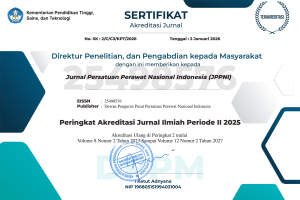
Jurnal Persatuan Perawat Nasional Indonesia (JPPNI)





 Email this article
 Open Access
 Subscription Access
A School-Based RISE Intervention to Improve Adolescent Reproductive Health Knowledge, Attitudes and Self- Reported Skills: A Quasi-Experimental Study
Abstract
Objective
This study examined the effectiveness of the Reproductive Information for Healthy Empowerment (RISE) intervention in promoting improvements in reproductive health knowledge, attitudes, and self-reported skills among female adolescents.
Methods
A quasi-experimental pre-test–post-test control group study was conducted among 130 female students aged 15–19 years from a vocational health school in Indonesia. Participants were recruited using convenience sampling and allocated at the class level to an intervention group (n = 65) and a control group (n = 65). The RISE intervention was delivered over four weeks through structured modules combining video-based learning and interactive discussions. Data collection was conducted using a structured questionnaire assessing reproductive health knowledge, attitudes, and self-reported skills. Statistical analyses included paired and independent t-tests, followed by multivariable linear regression to adjust for potential confounders.
Results
The intervention group demonstrated significantly greater improvements in reproductive health knowledge (mean difference = 1.91, p < 0.001), attitudes (mean difference = 3.63, p < 0.001), and self-reported skills (mean difference = 1.15, p = 0.003) compared with the control group. Multivariable analysis confirmed that the RISE intervention remained significantly associated with improvements in all outcomes after adjustment for confounding variables.
Conclusion
The RISE intervention effectively improved adolescents’ reproductive health knowledge, attitudes, and self-reported skills, supporting its integration into school-based reproductive health promotion programs.
References
Adjie, J.S., Kurniawan, A.P., & Surya, R. (2022). Knowledge, attitude, and practice towards reproductive health issue of adolescents in rural area, Indonesia: A cross-sectional study. The Open Public Health Journal, 15(1), 1-7. http://dx.doi.org/10.2174/18749445-v15-e2206275
Adnin, W., & Intan, Z. (2024). Hubungan tingkat pengetahuan kesehatan reproduksi remaja dengan sikap seksual pranikah di SMA KP 3 Paseh Kabupaten Bandung. Jurnal Kesehatan, 13(1), 110-121. https://doi.org/10.37048/kesehatan.v13i1.395
Anisah, S. (2020). Program pelayanan kesehatan peduli remaja di puskesmas. HIGEIA (Journal of Public Health Research and Development), 4(Special 4), 846-854. https://doi.org/10.15294/higeia.v4iSpecial 4.37007
Auri, K., Jusuf, E.C., & Ahmad, M. (2022). Strategi layanan kesehatan reproduksi pada remaja: literature review. Faletehan Health Journal, 9(01), 20–36. https://doi.org/10.33746/Fhj.V9i01.325
Badan Pusat Statistik. (2027). Statistik Indonesia 2027. Retrieved from https://www.bps.go.id/id/publication/2017/08/02/a89a2789e9ff45b2bc4e4cb5/child-marriage-in-indonesia-2013-and-2015.html
Bourke, A., Cullen, C., & Maunsell, C. (2025). Preparing to teach relationships and sexuality education: student teachers’ perceived knowledge and attitudes. Sex Education, 25(3), 341–358. https://doi.org/10.1080/14681811.2024.2337860
Chan, H.H.-K., Kwong, H.Y.C., Shu, G.L.F., Ting, C.Y., & Lai, F.H.-Y. (2021). Effects of experiential learning programmes on adolescent prosocial behaviour, empathy, and subjective well-being: A systematic review and meta-analysis. Frontiers in Psychology, 12, 709699. https://doi.org/10.3389/fpsyg.2021.709699
Cheek, C., Fleming, T., Lucassen, M.F., Bridgman, H., Stasiak, K., Shepherd, M., & Orpin, P. (2015). Integrating health behavior theory and design elements in serious games. Jmir Mental Health, 2(2), E11. https://doi.Org/10.2196/Mental.4133
Choi, Y.M., Noh, S., Seo, H.-J., & Yoon, J. (2025). School nurse-led educational interventions for sexual and reproductive health promotion in adolescents in high-income countries: A mixed-methods systematic review protocol. Bmj Open, 15(2), E087528. https://doi.Org/10.1136/Bmjopen-2024-087528
Curran, D.F., Matthews, J., & O’Donoghue, G. (2025). Developing theory and evidence based intervention content using the behaviour change wheel, theoretical domains framework, and the person-based approach: A worked example for an intervention targeting sedentary behaviour with people living with obesity. Plos One, 20(12), E0338196. https://doi.org/10.1371/Journal.Pone.0338196
Faul, F., Erdfelder, E., Buchner, A., & Lang, A.G. (2009). Statistical power analyses using G* Power 3.1: Tests for correlation and regression analyses. Behavior research methods, 41(4), 1149-1160.
Hagger, M.S., Cheung, M.W.-L., Ajzen, I., & Hamilton, K. (2022). Perceived behavioral control moderating effects in the theory of planned behavior: A meta-analysis. Health Psychology, 41(2), 155–167. https://doi.org/10.1037/Hea0001153
Katherina, L.K. (2023). Rural-to-urban reclassification and its impact on urbanization in Indonesia: A case study of West Java Province. IOP Conference Series: Earth and Environmental Science, 1263(1), 012015. https://doi.org/10.1088/1755-1315/1263/1/012015
Kementerian Kesehatan Republik Indonesia. (2022). Profil kesehatan Indonesia tahun 2022. Retrieved from https://kemkes.go.id/id/indonesia-health-profile-2022
Kustin, K., & Handayani, Y. (2024). Konseling teman tentang keterampilan reproduksi kesehatan remaja. Jurnal Kesehatan Komunitas (Journal of Community Health), 10(1), 96–103. https://doi.org/10.25311/Keskom.Vol10.Iss1.1647
Oktaviani, L., Mufarikhah, L., Hanifa, S., & Tahun, O.D. (2024). The role of health education: Changing knowledge and attitude of adolescents in providing reproductive health. Jurnal Penelitian Pendidikan IPA, 10(11), 8500–8506. https://doi.org/10.29303/jppipa.v10i11.8723
Pham, T., Goto, D., & Kakinaka, M. (2025). Adolescents’ risky online behaviors and social desirability bias in Vietnam: Privacy disclosure and pornography use. Cyberpsychology, Behavior, And Social Networking, 28(4), 266–274. https://doi.org/10.1089/Cyber.2024.0368
Pinandari, A.W., Kågesten, A.E., Li, M., Moreau, C., Van Reeuwijk, M., & Wilopo, S.A. (2023). Short-term effects of a school-based comprehensive sexuality education intervention among very young adolescents in three urban Indonesian settings: A quasi-experimental study. Journal of Adolescent Health, 73(1), S21–S32. https://doi.org/10.1016/J.Jadohealth.2023.01.030
Purwatyningsih, E., & Nursanti, I. (2024). Model teori konsep keperawatan Nola J. Pender ‘Health Promotion Model’. Journal of Health and Medical Research, 4(1), 76–85.
Rahmadyanti, Kartiwi, Apriyanti, Febriyanti, F., & Fitriyani, L. (2025). The Effectiveness of video-based health education in improving adolescents’ awareness of premarital sexual behavior. Jurnal Penelitian Pendidikan IPA, 11(11), 1303–1308. https://doi.org/10.29303/Jppipa.V11i11.12774
Rahmawati, S., Setyowati, S., Budiati, T., & Rachmawati, I.N. (2023). Faktor-faktor yang memengaruhi kesehatan reproduksi remaja. Journal of Telenursing (Joting), 5(2), 2632–2640. https://doi.org/10.31539/Joting.V5i2.7713
Saquing, J.B., Phichachan, N., Mathai, M.M., & Ernest, S. (2025). Role of school nurses in promoting adolescent health: Aligned with SDG 3 & SDG 11. (2025). Vascular and Endovascular Review, 8(4s), 59-67.
Sari, M., & Wahyono, T.Y.M. (2023). Analisis pengetahuan dan perilaku beresiko pada remaja terhadap kesehatan reproduksi. Jurnal Ners Pahlawan, 4(2), 88–96. https://doi.org/10.31004/jn.v8i1.21216
Setyowati, H., Sofiyanti, I., & Widyawati, S.A. (2022). Pemberdayaan remaja dalam optimalisasi kesehatan reproduksi remaja di Ma Miftahul Huda Tayu. Indonesian Journal of Community Empowerment (Ijce), 4(1), 22-28 https://doi.org/10.35473/Ijce.V4i1.1631
Tesfaye, Y., & Agenagnew, L. (2020). Knowledge, attitude, and practices of jimma teacher training college students toward risky sexual behaviors, Jimma, Ethiopia. Sexual Medicine, 8(3), 554–564. https://doi.org/10.1016/J.Esxm.2020.04.006
Wardiati, W., Septiani, R., Agustina, A., Ariscasari, P., Arlianti, N., & Mairani, T. (2023). Reproductive health literacy of adolescents at public Islamic school: A cross-sectional study in Indonesia. Al-Sihah: The Public Health Science Journal, 15(1), 12–22. https://doi.org/10.24252/al-sihah.v15i1.33133
UNICEF. (2024). Adolescent health and development in Indonesia. Retrieved from https://www.unicef.org/indonesia/health/reports/adolescent-health-profile
World Health Organization. (2021). WHO guideline on school health services. Retrieved from https://www.who.int/publications/i/item/9789240029392
World Health Organization. (2024). Adolescent sexual and reproductive health. Retrieved from https://www.who.int/health-topics/adolescent-sexual-and-reproductive-health
DOI: http://dx.doi.org/10.32419/jppni.v11i2.904
Article Metrics
Abstract view : 138 timesPDF - 56 times
Refbacks
- There are currently no refbacks.